September 25, 2026 · By @limitlessdeng
I checked 10 DTC brands' websites. Only 2 problems actually cost them money.
Graza, Brightland, Fishwife, Great Jones, Wild One, Krave, Starface, Taylor Stitch, Tentree and Nomatic, checked page by page, then against what Google and AI shopping assistants actually show.
If you've ever run an SEO checker, you know the screen: a big red number. "Your site has 1,284 issues."
This week I took 10 brands most people in DTC have heard of: Graza, Brightland, Fishwife, Great Jones, Wild One, Krave Beauty, Starface, Taylor Stitch, Tentree and Nomatic, and checked their websites. Between them, the checks flagged thousands of problems.
Then I went through them one by one. I opened the raw pages, and I looked at what Google actually shows people who search for these brands.
The result: almost none of those "errors" cost these brands anything. Two things did. (And, confession up front: the biggest category of false alarms came from my own tool. More on that below.)
1. AI shopping assistants can't see the product (Tentree)
More and more people skip Google and just ask ChatGPT: "recommend an organic cotton hoodie."
An AI assistant can only recommend what it can read. And the crawlers that fetch pages for ChatGPT, Claude and Perplexity mostly read a page's raw HTML. They don't wait for the page's JavaScript to run.
Tentree's product pages look great in a browser: name, photos, reviews, price, description. In the raw HTML, the product name, price and description are only packed into data for the page's JavaScript to draw later, and the review count isn't there at all. Here is the same page with its scripts removed, which is roughly what a crawler that doesn't run JavaScript gets:
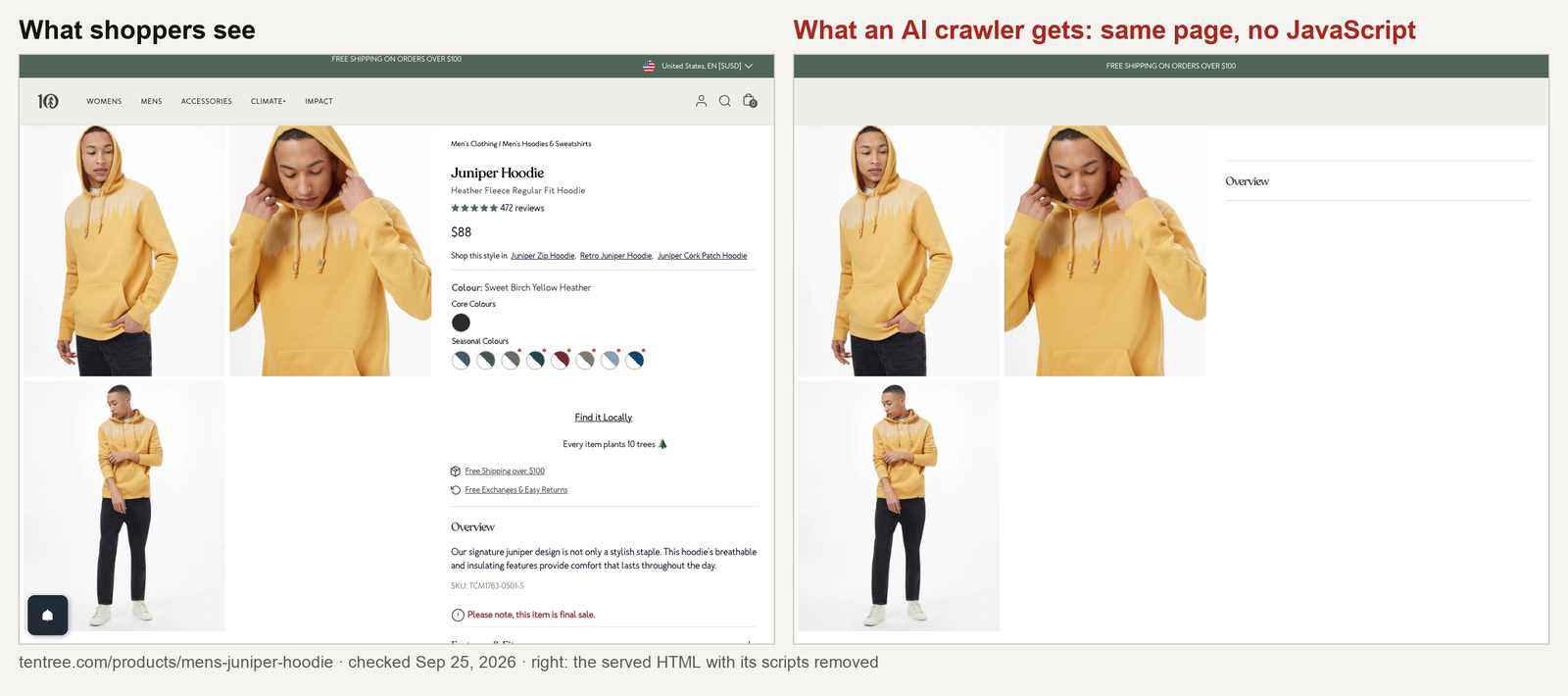
Every product page I checked is built this way. They all come from the same template, and there are thousands of them.
Google isn't affected: it does run the JavaScript, and Tentree's results show the price and description just fine. To an AI assistant, though, Tentree's catalogue is mostly photos and a menu.
Compare Brightland, Wild One and Nomatic from the same batch: the product name, price and description are written straight into the page, so anything that reads it sees them.
Taylor Stitch has a milder version. Its product pages are fine, but the product grid on category pages only appears once JavaScript runs. An AI assistant opening "Men's Shirts" finds an empty shelf.
The 30-second test: on one of your product pages, right-click → "View page source", then Ctrl+F for the product name. If it isn't there, AI assistants can't see it either.
2. The sentence you didn't write, Google wrote for you (Great Jones)
Every page can carry a short description that Google shows under its title in the results. For a brand's homepage, that's its first sentence to everyone who searches for it.
Great Jones's homepage doesn't have one. So when you search "great jones cookware", this is what Google puts under their name:
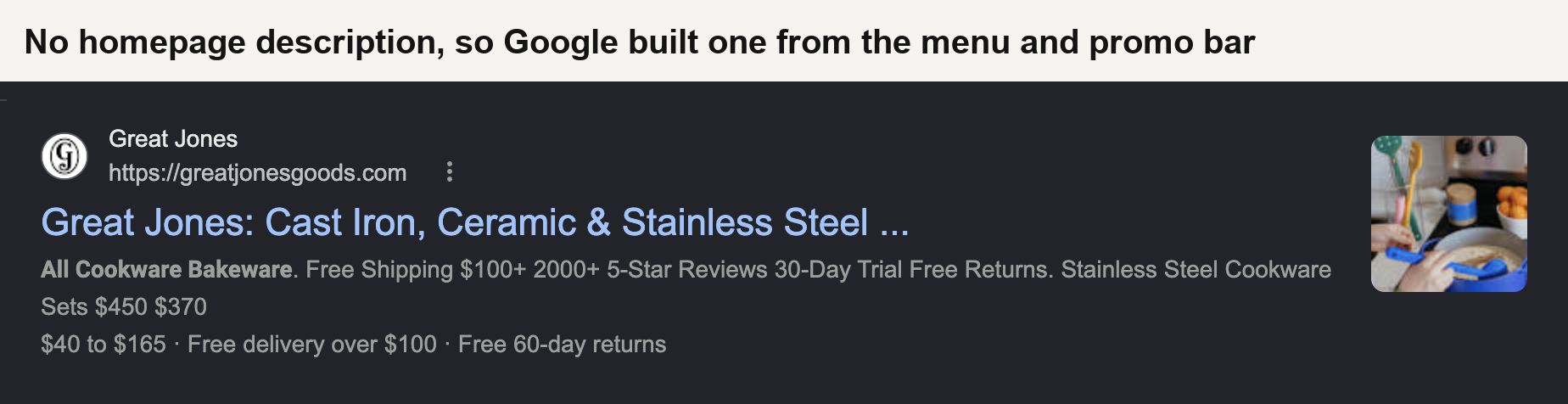
Google stitched that together from the menu and the promo bar.
It's not a disaster, but it hands the most valuable line a brand has in search to whatever text happens to be on the page. The fix takes five minutes: write one sentence and put it in the homepage's SEO settings. Wild One has the same gap on about 148 pages, collection pages included.
Looks scary, isn't
The checks were loudest about these. After looking at each one, none of them is urgent:
- "Invalid structured data" on nearly every page of Graza, Fishwife, Great Jones and Nomatic. Mostly my own tool's mistake. Shopify writes image addresses as
//cdn.shopify.com/…, leaving off thehttps:. That's perfectly valid, and Google reads it fine, but my checker called it an error, which means nearly every Shopify store got flagged. It's fixed. What's left on Graza is minor: blog dates written in a non-standard format. - Taylor Stitch "sends 2,000+ product pages somewhere else". Look closer and they're all sold-out products, each pointing Google to its category: "this one's gone, see the similar ones". Everything currently on sale is fine. That's a smart way to handle discontinued products, and worth copying.
- Fishwife "hides 13 products from Google". They're all wholesale packs, which shouldn't be in search results anyway. Deliberate.
- Graza's product pages are "missing a main heading". Technically true. But search "graza sizzle olive oil" and Google's AI Overview quotes Graza's own site to describe the oil. Google understands the page just fine.
- No star ratings in Tentree's search results. I was going to blame missing rating data. Then I checked Graza, whose pages do include rating data, and its results show no stars either. Google decides when to show stars; having the data doesn't guarantee them. No conclusion here.
My take
SEO tools, including the one I build, share a habit: they report everything they can detect, not the things that cost you money. A red 1,284 makes people either panic or stop looking.
For these 10 stores, the work that fits in an afternoon and actually pays off is two things:
- Make sure something that doesn't run JavaScript, like an AI assistant, can still read your products.
- Give your homepage and collection pages one sentence of description each, so Google doesn't have to improvise.
Everything else can wait until those two are done.
Check your own store
Free, no sign-up: loomaly.com/check/yourdomain.com. It reads your site the way an AI crawler does and ranks what it finds by what it's likely to cost you.
Or send me your store's address on X (@limitlessdeng). I'll look at a few by hand and post what I find.
Method: checked September 25, 2026. Up to 20 pages per store, sampled from the sitemap by page type; product and category pages also requested as Googlebot and as GPTBot (ChatGPT's crawler); results checked against US Google search.
Check your own site
Free, no sign-up. It reads your sitemap and about 20 pages the way a crawler does.
Free, no sign-up. We read your sitemap and about 20 pages.